


Pass CCDAK Exam Latest Practice Questions Updated on May 19, 2026
Confluent CCDAK Study Guide Archives
The CCDAK certification exam is designed to test the knowledge and skills of developers in building Kafka-based applications. CCDAK exam covers topics such as Kafka architecture, configuration, security, performance tuning, and application development using Kafka APIs. Confluent Certified Developer for Apache Kafka Certification Examination certification is vendor-neutral, meaning it is not tied to any particular distribution of Kafka, and is based on the most up-to-date version of Kafka available at the time of the exam.
Confluent Certified Developer for Apache Kafka (CCDAK) certification examination is a comprehensive test designed to evaluate the proficiency of developers in designing, building, and deploying Apache Kafka-based applications using Confluent's platform. CCDAK exam is a rigorous assessment of the candidate's knowledge and skills, covering various topics such as Kafka architecture, data modeling, stream processing, and security.
NEW QUESTION # 29
(You are configuring a source connector that writes records to an Orders topic.
You need to send some of the records to a different topic.
Which Single Message Transform (SMT) is best suited for this requirement?)
- A. HeaderFrom
- B. TombstoneHandler
- C. RegexRouter
- D. InsertField
Answer: C
Explanation:
According to the official Apache Kafka Connect documentation, RegexRouter is the SMT specifically designed to dynamically change the destination topic name of records produced by a connector. It works by applying a regular expression to the original topic name and rewriting it to a new topic name.
This makes RegexRouter the correct choice when some records must be routed to a different topic, typically in combination with connector-level logic, predicates, or multiple connectors. It is commonly used for topic renaming, topic versioning, or routing records to alternate topics.
InsertField (Option B) only adds metadata fields (such as topic, partition, or timestamp) to the record payload and does not affect routing. TombstoneHandler (Option C) is used to manage null-value records, especially with compacted topics. HeaderFrom (Option D) copies fields into headers but does not change the target topic.
Therefore, RegexRouter is the only SMT that directly supports changing the output topic, as documented in the Kafka Connect SMT reference.
NEW QUESTION # 30
A Kafka producer application wants to send log messages to a topic that does not include any key. What are the properties that are mandatory to configure for the producer configuration? (select three)
- A. partition
- B. key
- C. value
- D. value.serializer
- E. bootstrap.servers
- F. key.serializer
Answer: D,E,F
Explanation:
Both key and value serializer are mandatory.
NEW QUESTION # 31
Partition leader election is done by
- A. Zookeeper
- B. Vote amongst the brokers
- C. The Kafka Broker that is the Controller
- D. The consumers
Answer: A
Explanation:
The Controller is a broker that is responsible for electing partition leaders
NEW QUESTION # 32
You create a topic named loT-Data with 10 partitions and replication factor of three.
A producer sends 1 MB messages compressed with Gzip.
Which two statements are true in this scenario?
(Select two.)
- A. Compression type will be stored in batch attributes.
- B. All compressed messages will be stored in the same topic partition.
- C. By default, compression is the producer's responsibility.
- D. The message is already compressed so it will not be serialized.
Answer: A,C
Explanation:
* A:Kafka batches storecompression metadata in their headers, indicating how the batch was compressed.
* B:Compression is controlled via theproducer config compression.type, which defaults to none.
Producers explicitly set Gzip or other formats.
FromKafka Producer Docs:
"Compression is done by the producer, and the type is stored in the message batch metadata. The broker does not recompress."
* C is false: messages are serializedbeforecompression.
* D is false: messages without keys are distributed acrossmultiple partitions.
Reference:Kafka Producer Configs > compression.type
NEW QUESTION # 33
Which configuration is used to determine which directory the connectors are stored in?
- A. group.id
- B. plugin.path
- C. status.storage.topic
- D. offset.storage.topic
Answer: B
NEW QUESTION # 34
You have a consumer group with default configuration settings reading messages from your Kafka cluster.
You want to optimize its throughput so the consumer group processes more messages in the same amount of time.
Which changes increase the consumption throughput?
- A. Decrease the session timeout of each consumer.
- B. Disable auto commit and have the consumers manually commit offsets.
- C. Increase the number of bytes the consumers read with each fetch request.
- D. Remove some consumers from the consumer group.
Answer: C
NEW QUESTION # 35
You are experiencing low throughput from a Java producer.
Metrics show low I/O thread ratio and low I/O thread wait ratio.
What is the most likely cause of the slow producer performance?
- A. There is a bad data link layer (layer 2) connection from the producer to the cluster.
- B. The producer code has an expensive callback function.
- C. The producer is sending large batches of messages.
- D. Compression is enabled.
Answer: B
Explanation:
Low I/O thread activity with blocked throughput often indicates thatproducer callbacks are consuming too much time, causing the sender thread to block while waiting for onCompletion() to finish.
FromKafka Producer Performance Guide:
"Expensive logic in callbacks (e.g., I/O or complex computation) can block the sender thread, reducing throughput."
* Compression (A) may slightly impact CPU but not I/O thread usage.
* Large batches (B) improve throughput if managed correctly.
* A Layer 2 network issue (C) would lead to packet loss, not specifically low callback metrics.
Reference:Kafka Producer Metrics and Performance Tuning
NEW QUESTION # 36
Which function does ZooKeeper offer in Kafka?
- A. Authentication
- B. Partition assignment
- C. Consumer group rebalancing
- D. Controller re-election
Answer: D
NEW QUESTION # 37
The producer code below features a Callback class with a method called onCompletion().
In the onCompletion() method, when the request is completed successfully, what does the value metadata.
offset() represent?
- A. Its position in the producer's batch of messages
- B. The sequential ID of the message committed into a partition
- C. The ID of the partition to which the message was committed
- D. The number of bytes that overflowed beyond a producer batch of messages
Answer: B
Explanation:
The offset in the RecordMetadata object returned by the producer represents the position of the record in the partition - i.e., the sequential ID assigned by Kafka once the message is committed.
From Kafka Producer API Documentation:
"The offset is the position of the record in the partition. This is a unique, sequential number assigned by the broker." D refers to metadata.partition(), not offset().
B and C are unrelated to how Kafka handles committed offsets.
Reference: Kafka Producer Java API > RecordMetadata
NEW QUESTION # 38
Which two statements about Kafka Connect Single Message Transforms (SMTs) are correct?
(Select two.)
- A. SMTs are often used to join multiple records from a source data system into a single Kafka record.
- B. Multiple SMTs can be chained together and act on source or sink messages.
- C. SMT functionality is included within Kafka Connect converters.
- D. Masking data is a good example of an SMT.
Answer: B,D
Explanation:
SMTs (Single Message Transforms) arelightweight transformationsapplied to individual messages as they pass through Kafka Connect.
* Chaining SMTs: You can applymultiple SMTsin sequence by defining them in order in the connector config.
* Masking or modifying fieldsis acommon use case(e.g., redacting sensitive data).
FromKafka Connect Documentation:
"Single Message Transforms (SMTs) are applied to individual messages. You can chain multiple SMTs together."
* SMTsdo not perform joins(B is incorrect).
* Converters and SMTs areseparate concerns(D is incorrect).
Reference:Kafka Connect Transformations Guide
NEW QUESTION # 39
Which two statements are correct when assigning partitions to the consumers in a consumer group using the assign() API?
(Select two.)
- A. It is mandatory to subscribe to a topic before calling assign() to assign partitions.
- B. The consumer group will not be rebalanced if a consumer leaves the group.
- C. The consumer chooses which partition to read without any assignment from brokers.
- D. All topics must have the same number of partitions to use assign() API.
Answer: B,C
Explanation:
Using assign() gives manual control over partition assignment. In this mode:
B is true: The application chooses partitions directly without involving the group coordinator.
C is true: Since no group coordination occurs, no rebalancing happens if a consumer dies.
From Kafka Consumer API Docs:
"assign() manually assigns a list of partitions to this consumer. No coordination takes place and no rebalancing is triggered." A is false: subscribe() and assign() are mutually exclusive.
D is incorrect: Partitions don't need to be equal across topics.
Reference: Kafka Consumer Java API > assign() and subscribe()
NEW QUESTION # 40
You want to perform table lookups against a KTable everytime a new record is received from the KStream.
What is the output of KStream-KTable join?
- A. Kstream
- B. You choose between KStream or KTable
- C. KTable
- D. GlobalKTable
Answer: A
Explanation:
Here KStream is being processed to create another KStream.
NEW QUESTION # 41
Match the testing tool with the type of test it is typically used to perform.
Answer:
Explanation:
Explanation:
Unit Testing # MockProducer
Integration Testing # Testcontainers
Performance Testing # Trogdor
Mock Data Generation # Connect Datagen
MockProducer: Simulates a Kafka producer in unit tests (no real broker interaction).
Testcontainers: Spawns Kafka in Docker for real environment testing.
Trogdor: Kafka's built-in performance load testing framework.
Connect Datagen: Creates sample source records for test and demo purposes.
From Kafka Developer Tools Guide:
"Kafka developers commonly use MockProducer for unit tests, Testcontainers for integration, and Trogdor for performance tests." Reference: Kafka Testing and Tools Overview
NEW QUESTION # 42
Match the topic configuration setting with the reason the setting affects topic durability.
(You are given settings like unclean.leader.election.enable=false, replication.factor, min.insync.replicas=2)
Answer:
Explanation: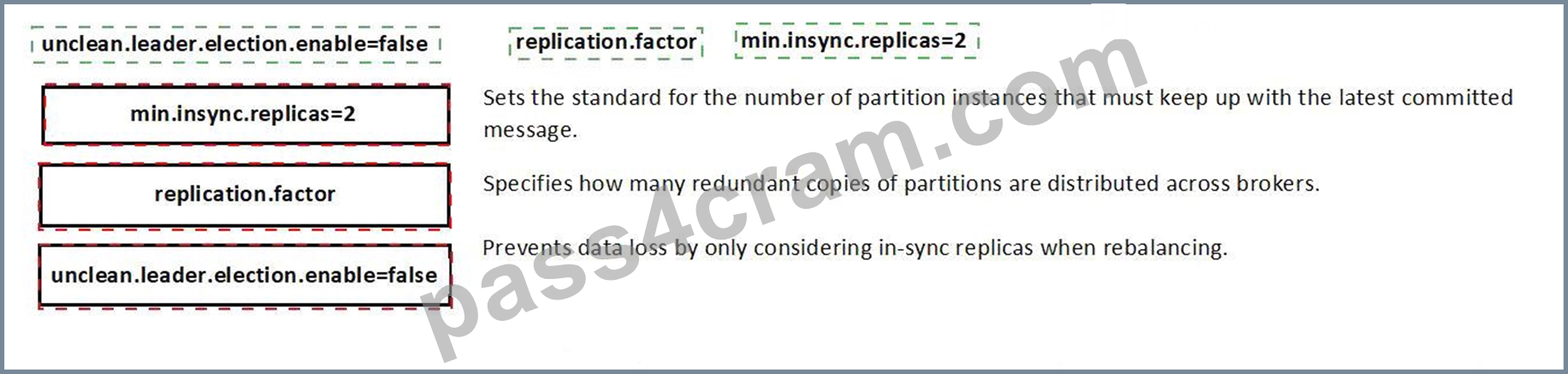
* unclean.leader.election.enable=false# Prevents data loss by only considering in-sync replicas when rebalancing.
* replication.factor# Specifies how many redundant copies of partitions are distributed across brokers.
* min.insync.replicas=2# Sets the standard for the number of partition instances that must keep up with the latest committed message.
* unclean.leader.election.enable=false ensures that onlyin-sync replicascan be elected as leaders. If disabled, an out-of-sync replica may become leader, potentially leading to data loss.
* replication.factor defineshow many brokerswill maintain copies of each partition, directly impacting durability and availability.
* min.insync.replicas determineshow many replicas must acknowledgea write when acks=all is used, enforcing write durability.
Reference:Apache Kafka Topic Configuration Documentation
NEW QUESTION # 43
What are stateful operations in Kafka Streams API? (Choose 2.)
- A. joins
- B. map
- C. branch
- D. windowing
Answer: A,D
NEW QUESTION # 44
How does a consumer commit offsets in Kafka?
- A. It interacts with the Group Coordinator broker
- B. It directly commits the offsets in Zookeeper
- C. It directly sends a message to the __consumer_offsets topic
Answer: A
Explanation:
Consumers do not directly write to the __consumer_offsets topic, they instead interact with a broker that has been elected to manage that topic, which is the Group Coordinator broker
NEW QUESTION # 45
Select all that applies (select THREE)
- A. min.insync.replicas is a producer setting
- B. min.insync.replicas matters regardless of the values of acks
- C. min.insync.replicas only matters if acks=all
- D. min.insync.replicas is a topic setting
- E. acks is a topic setting
- F. acks is a producer setting
Answer: C,D,F
Explanation:
acks is a producer setting min.insync.replicas is a topic or broker setting and is only effective when acks=all
NEW QUESTION # 46
If a topic has a replication factor of 3...
- A. Each partition will live on 3 different brokers
- B. 3 replicas of the same data will live on 1 broker
- C. Each partition will live on 2 different brokers
- D. Each partition will live on 4 different brokers
Answer: A
Explanation:
Replicas are spread across available brokers, and each replica = one broker. RF 3 = 3 brokers
NEW QUESTION # 47
How do you create a topic named test with 3 partitions and 3 replicas using the Kafka CLI?
- A. bin/kafka-topics.sh --create --bootstrap-server localhost:2181 --replication-factor 3 --partitions 3 --topic test
- B. bin/kafka-topics.sh --create --broker-list localhost:9092 --replication-factor 3 --partitions 3 --topic test
- C. bin/kafka-topics-create.sh --zookeeper localhost:9092 --replication-factor 3 --partitions 3 --topic test
- D. bin/kafka-topics.sh --create --bootstrap-server localhost:9092 --replication-factor 3 --partitions 3 --topic test
Answer: D
Explanation:
As of Kafka 2.3, the kafka-topics.sh command can take --bootstrap-server localhost:9092 as an argument. You could also use the (now deprecated) option of --zookeeper localhost:2181.
NEW QUESTION # 48
......
Confluent is a company that provides a distributed streaming platform built on Apache Kafka. The Confluent Certified Developer for Apache Kafka (CCDAK) Certification Exam is designed for developers who want to demonstrate their knowledge and skills in building and managing Kafka-based applications using Confluent's platform. CCDAK exam is an industry-recognized certification that validates a developer's ability to work with Kafka and Confluent.
CCDAK Questions Prepare with Learning Information: https://validexam.pass4cram.com/CCDAK-dumps-torrent.html